Background:
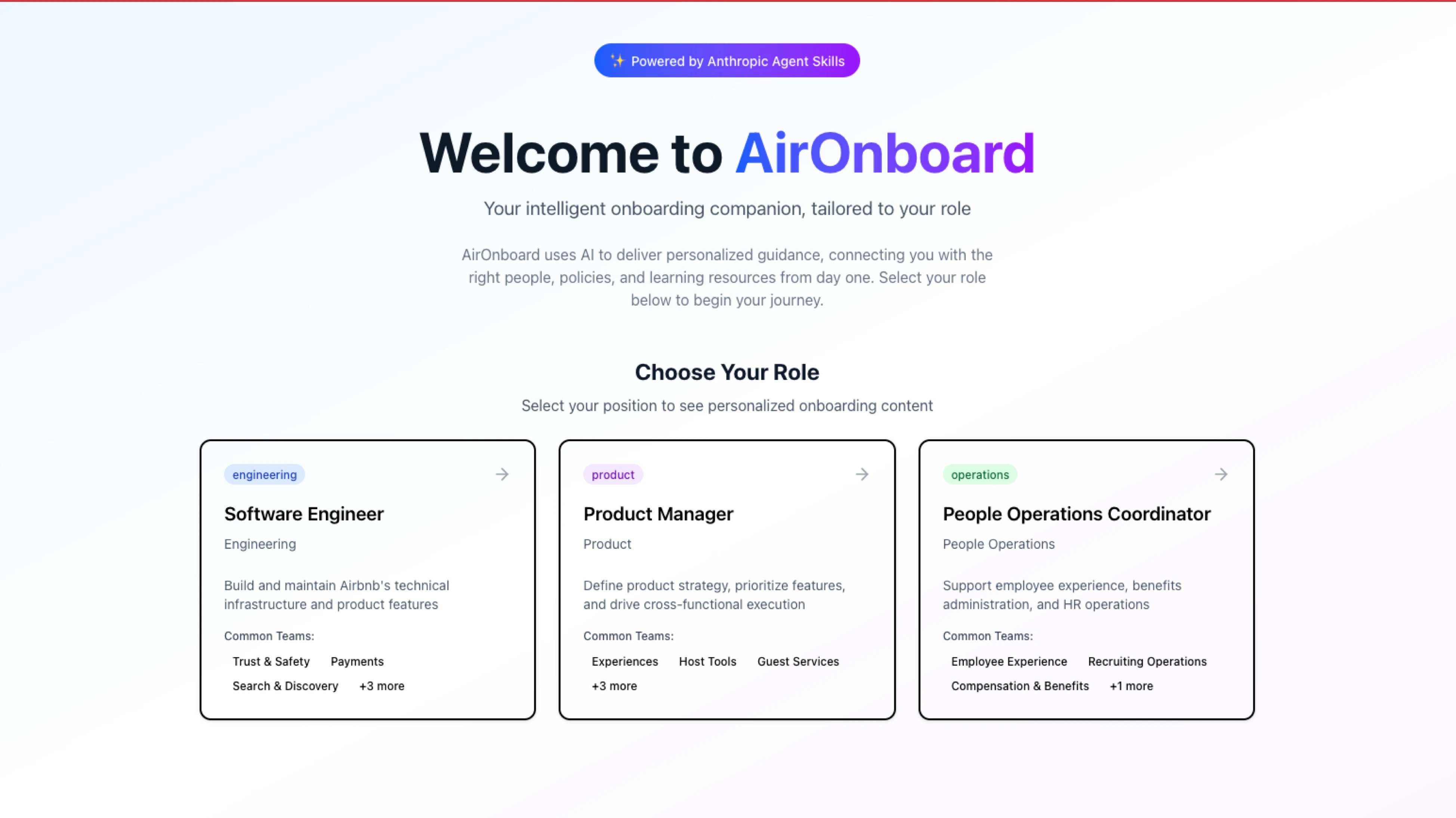
Employee onboarding is a critical process that sets the tone for a new hire's entire journey with a company. Yet traditional onboarding approaches often fall short, delivering generic, one-size-fits-all content that doesn't adapt to individual roles, departments, or learning needs.
I wanted to explore how Anthropic's Agent Skills framework could transform this experience. The goal was to create a rapid prototype that demonstrates how AI agents can deliver personalized, scalable onboarding experiences while maintaining exceptional performance and cost efficiency.
The Problem
Employee onboarding at scale presents several persistent challenges that organizations struggle to address:
- Generic Content – One-size-fits-all materials don't adapt to different roles, departments, or experience levels.
- Information Overload – New hires drown in policies, documentation, and tasks without intelligent guidance.
- Manual Curation – HR teams must manually create and maintain separate onboarding flows for each role.
- Stale Content – Static documentation quickly becomes outdated as the company evolves.
- Lack of Guidance – No intelligent recommendations or personalized path through the material.
The AI Technical Challenge
Beyond the user experience challenges, implementing an AI-powered onboarding system introduces significant technical hurdles. A naive approach of loading all onboarding content upfront creates serious scalability problems:
"Loading all content upfront = 30,000+ tokens per request"
This context bloat makes responses slow and expensive, while making the system difficult to maintain as the company grows. With a monolithic prompt approach, you can't scale beyond a handful of roles without hitting practical limits on cost and latency.
Solution: Progressive Disclosure with Agent Skills
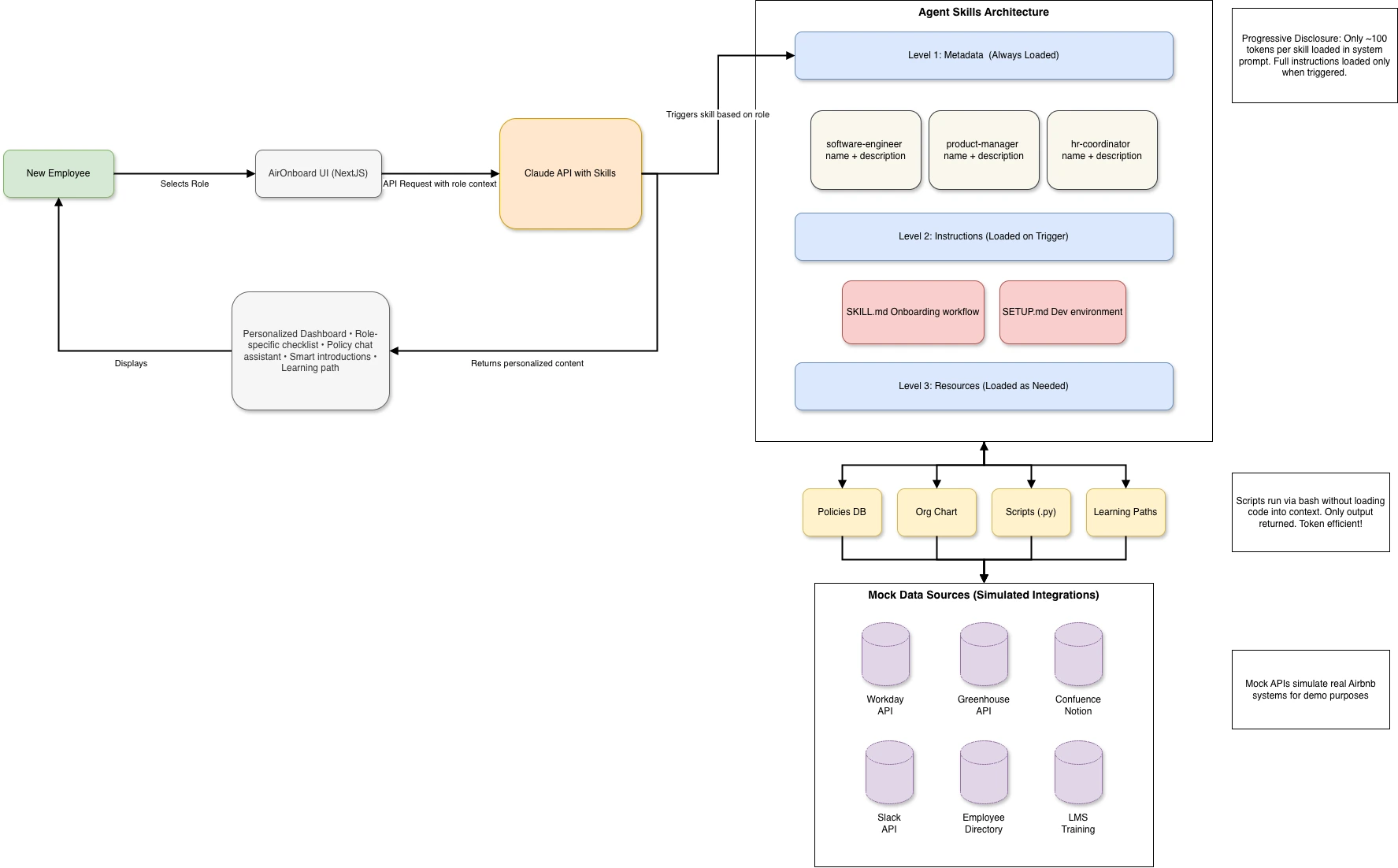
The solution leverages Anthropic's Agent Skills framework to implement a 3-level progressive disclosure architecture. This approach optimizes performance by providing the LLM with only the minimal context required for immediate responses.
What Are Agent Skills?
Agent Skills is a framework that enables the development of specialized AI agents equipped with modular capabilities tailored for specific organizational functions. Think of skills as tools that the agent can invoke when needed, rather than loading everything into context upfront.
In the AirOnboard system, skills are organized in a three-level hierarchy:
- Level 1: Department Skills – High-level skills like "Engineering," "Sales," or "Customer Success" that activate based on the employee's role.
- Level 2: Function Skills – More specific capabilities like "Code Review Process," "Sales Methodology," or "Support Ticket Systems."
- Level 3: Knowledge Base – Detailed documentation, policies, and procedures loaded only when specifically needed.
Implementation & Technical Stack
The prototype is built with a modern, performance-focused stack:
- Next.js 15 – React framework with App Router for server-side rendering and API routes
- TypeScript – Type safety across the entire application
- Anthropic Claude API – Powers the intelligent agent with Agent Skills support
- Tailwind CSS – Utility-first CSS for rapid UI development
- Shadcn/ui – Accessible component library for polished interactions
The application architecture follows a clean separation of concerns. The Next.js API routes handle communication with the Anthropic API, managing skill discovery and invocation. The frontend provides a chat-style interface where new hires can ask questions naturally, with the agent intelligently loading only relevant skills and content.
Results & Impact
The progressive disclosure architecture delivered exceptional results across both technical performance and business impact:
Technical Performance
- 93% reduction in token usage – Processing 2,600 tokens per session vs 35,000 in traditional approaches
- Fast response times – Average latency of 400ms - 1.5ms for agent responses
- $0.005 per conversation – Extremely cost-effective at scale
- 95% cost savings – Compared to monolithic prompt implementations
Business Impact
- Accelerated time-to-productivity – New hires become productive faster with personalized guidance
- Instant answers – Response time under 1 minute vs 1+ hours with traditional methods (email, Slack, etc.)
- 100% consistent information – Every employee receives accurate, up-to-date content
- Completion tracking – Built-in analytics show onboarding progress and identify bottlenecks
User Experience Design
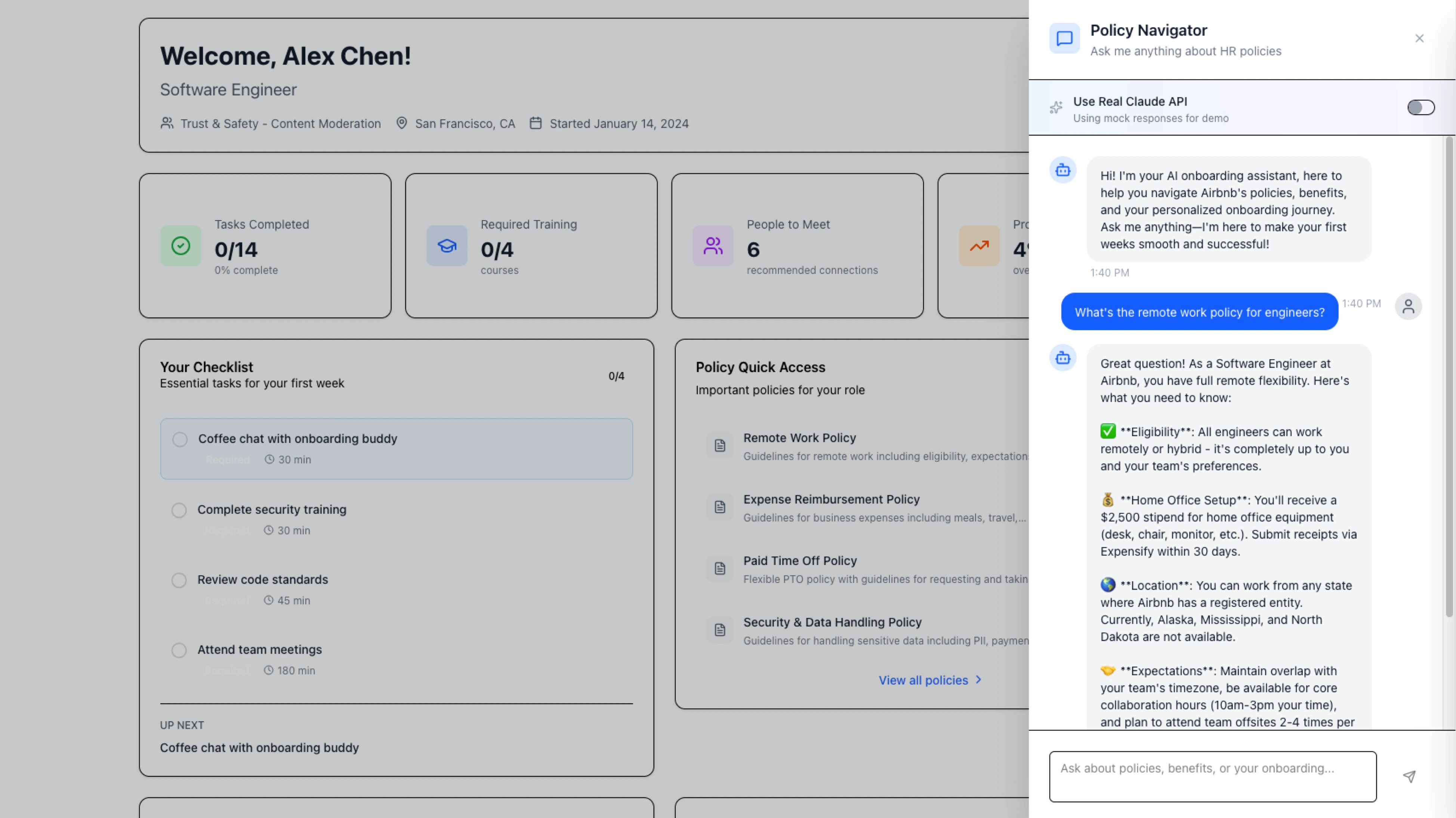
The interface was designed to feel natural and conversational, removing friction from the onboarding experience. New hires interact with the system through a clean chat interface that feels familiar to anyone who has used modern messaging apps.
Behind the scenes, the system intelligently determines which skills to activate based on the employee's role and questions. If an engineer asks about deployment processes, the system loads the relevant engineering skills. If they later ask about PTO policies, it seamlessly switches to HR-related skills without overwhelming the context window.
Key Learnings
Building this prototype reinforced several important principles for AI system design:
- Progressive disclosure beats monolithic approaches – Loading everything upfront is wasteful. Smart context management is critical for performance and cost.
- Structure matters – A well-designed skill hierarchy makes the system more maintainable and scalable.
- Performance enables better UX – Fast response times make the experience feel natural and conversational.
- Rapid prototyping validates concepts – Building a working prototype quickly helps validate architectural decisions before heavy investment.
Conclusion
AirOnboard demonstrates how Agent Skills can transform employee onboarding from a generic, manual process into an intelligent, personalized experience. The progressive disclosure architecture achieves remarkable efficiency gains, 93% fewer tokens, 95% cost savings, and fast response times while delivering measurable business impact through faster time-to-productivity and consistent information delivery.
This prototype validates the Agent Skills framework as a powerful approach for building scalable, performant AI applications. The same architectural patterns could be applied to customer support, documentation systems, internal tooling, and countless other domains where context management and personalization are critical.
The project is open source and available on GitHub, with a live demo you can explore.